PCIe - simple and powerful! PCI Express interface is the backbone of every computer, so using its full potential ensures maximum sensor speed, modularity, power efficiency, and lowest latency.
High-Speed PCIe cameras for scalable vision systems
As XIMEA, our approach is ‘one ecosystem, many solutions,’ providing a powerful architecture that requires only a few key components for peak efficiency. By adopting PCIe, we unlock maximum sensor speed and low latency. This high-bandwidth ecosystem offers a modular, future-proof platform that scales from compact embedded setups to complex multi-camera workstation assemblies.
PCIe is the backbone of modern computing and supersedes older standards like PCI to offer an interface with superior performance.
Our high-end cameras feature the latest sensors to deliver resolutions ranging from 0.5 to 245.7 Mpix. Our hardware ensures the swift and efficient transfer of image data required by demanding vision systems.
DMA (Direct Memory Access)
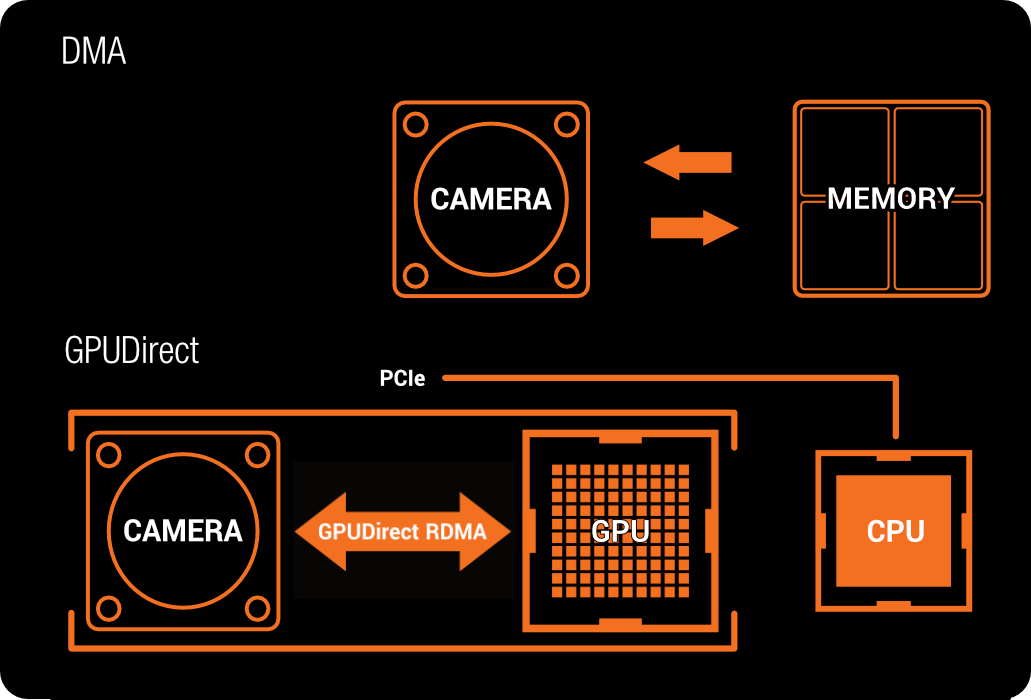
By utilizing Direct Memory Access (DMA), PCIe cameras write image data directly into the host PC's memory requiring just a minimal CPU intervention. This significantly lowers CPU load, preserving processing power for your actual image analysis. The result is a more stable, efficient system that avoids the bottlenecks common to CPU-dependent interfaces.
GPUDirect
GPUDirect RDMA is a technology that enables a direct path for data exchange between Nvidia GPUs and XIMEA cameras. GPUDirect is supported in the XIMEA API and makes image data directly accessible
in CUDA kernels.
How does PCIe work?
PCIe lanes
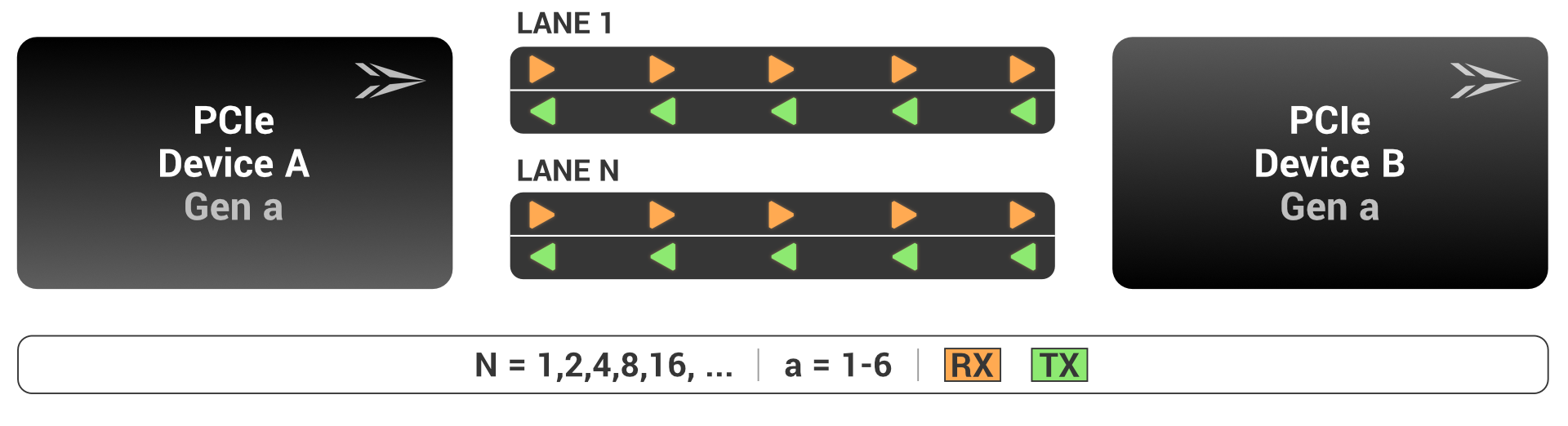
Beyond the PCIe generation, PCIe slot sizes (x1, x4, x8, x16) correspond to the number of available lanes and total bandwidth they deliver. Each lane is bidirectional sending and receiving data simultaneously (Tx, Rx), enabling fast and efficient communications between CPU, GPU, and peripherals.
Flexible bandwidth
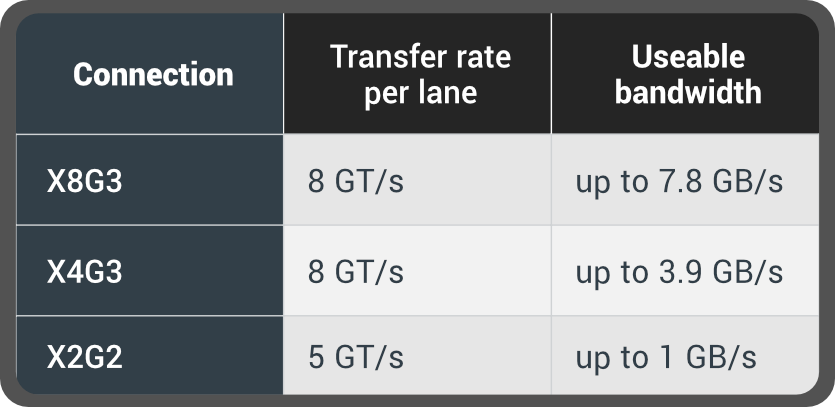
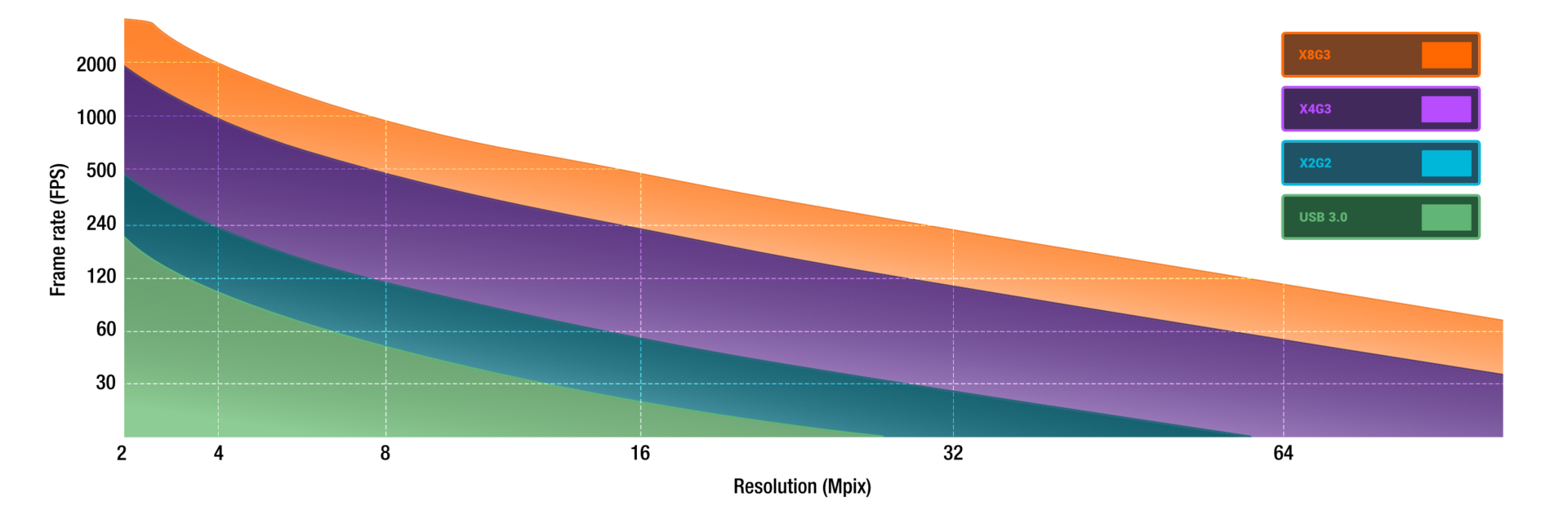
Beyond the number of lanes, each PCIe link also has a generation, which determines the bandwidth per lane. Together, these form a short connection descriptor used in our product naming.
For instance, an eight-lane, generation-three link is referred to as X8G3. The table on the left lists common combinations and their transfer rates.
PCIe switches
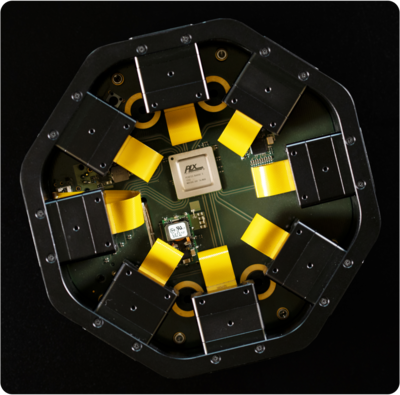
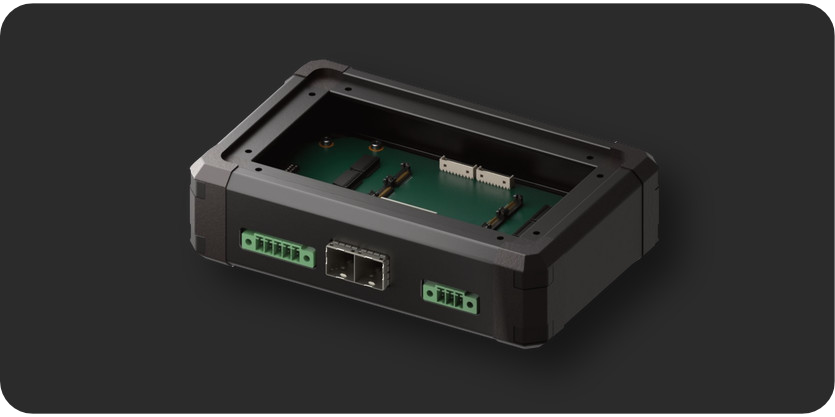
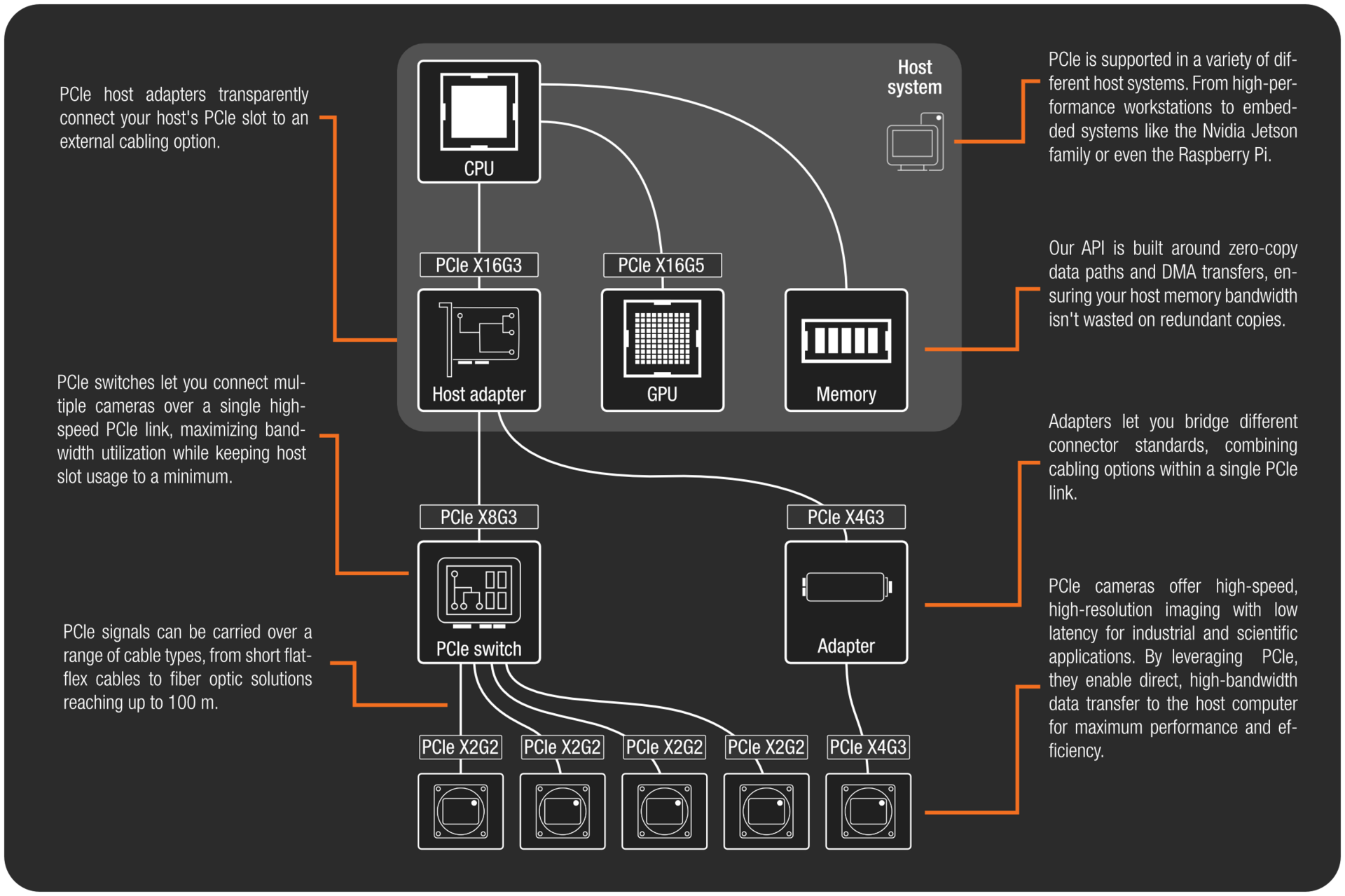
PCIe switches can be used to fan out a single high-bandwidth link from the host into multiple links for connected devices. This allows several cameras to share a single PCIe connection to the host system, making it possible to scale up the number of cameras without requiring additional PCIe slots.
For example, a single X8G3 link from the host to a PCIe switch provides enough upstream bandwidth for eight X2G2 cameras or two X4G3 cameras.
Component overview
Bandwidth driven ecosystem and multicamera assemblies
Only a few essential parts are needed for an XIMEA PCIe camera system to operate at peak efficiency. By taking advantage of PCIe’s scalability, XIMEA cameras and the wider ecosystem can be tailored to meet application-specific bandwidth and latency needs.
This flexibility allows for custom setups with the potential for future expansion. The ecosystem supports flat, flexible cables for short-range connections up to 3 meters. For applications requiring greater reach, fiber optic cables are available to extend the link distance up to 100 meters.
The system can be tailored effectively to meet different project requirements.
USB vs PCIe interfaces: Performance, flexibility, and use cases explained
In this video, Alex, a technology expert from the XIMEA team, breaks down the key differences between USB and PCIe camera interfaces. Three high-end camera models with the same Sony IMX530 sensor are used to examine the benefits of various interfaces.
Learn how to choose the ideal industrial camera solution for your application with practical comparison:
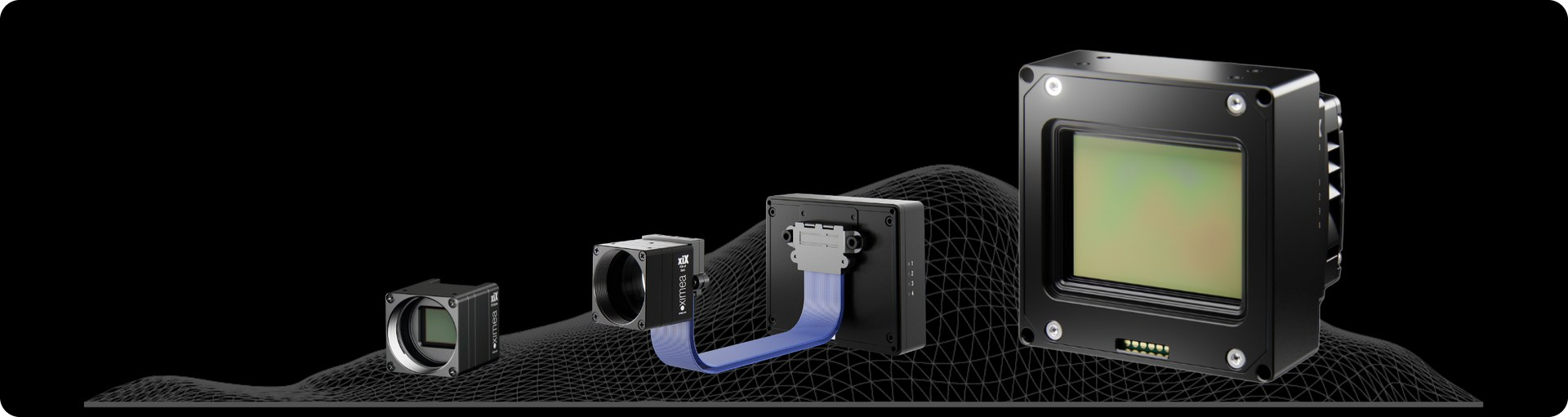
Our PCIe camera families range from compact xiX models for multi-camera setups and high-speed xiB cameras to large-format xiX-XL and fast xiX-Xtreme models. Thanks to detachable sensor heads, xiX-XL and xiX-Xtreme fit where space is tight while keeping heat away from the sensor.
Explore our industrial and scientific PCIe cameras below.