ximea

XIMEA PCIe cameras connect directly to the host over PCI Express – up to 64 Gbit/s over PCIe Gen 3. The cameras support DMA transfer to memory, and data transfer to the GPU is possible on Linux, which keeps latency low. A major benefit is the ability to easily combine these cameras with SoC (system on a chip) modules with a GPU, like the ones from NVIDIA.
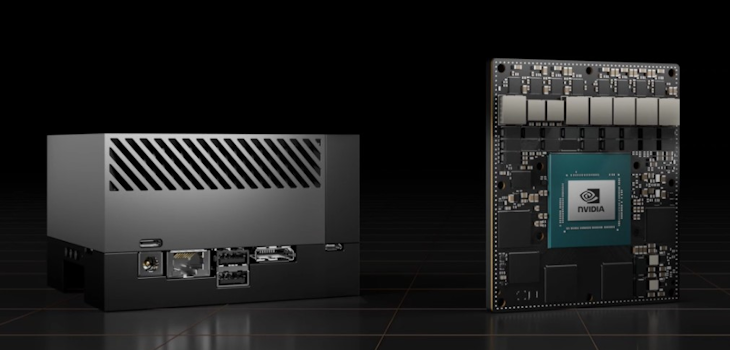
The NVIDIA Orin modules opened up new performance levels for using XIMEA high-speed, high-resolution PCIe cameras in embedded vision applications. The AGX Orin is the largest module of the Orin family.
XIMEA's technology partner MRTech tested XIMEA cameras with the Jetson AGX Orin in two test series. In both, images from the cameras were processed on the Orin GPU and streamed to a receiving computer.
Highlights: a single XIMEA camera streamed Full HD video at 390 fps with a glass-to-glass latency of only 24 ms, and 4K UHD video at 140 fps with 42 ms. Two 8.1 MP cameras ran side by side on the same module. This makes the combination a good fit for drones, robotics, medical devices and other applications where every millisecond counts.
Picture 1. Two MX081CG cameras, Jetson AGX Orin on the Forge carrier board, receiving laptop and the LatencyKit
The NVIDIA Jetson AGX Orin is the highest-performance module of the Jetson Orin family. It combines an NVIDIA Ampere architecture GPU with Tensor Cores, a multi-core Arm CPU, a hardware video encoder and a large number of PCIe Gen 4 lanes, which makes it possible to attach high-bandwidth PCIe cameras directly to the module. Together with XIMEA PCIe cameras it forms a compact, all-in-one vision system: image acquisition, GPU image processing and video encoding all run on one board, with no PC needed on the camera side.
Table 1. Jetson AGX Orin module variants (NVIDIA specification)
| Parameter | AGX Orin 32GB | AGX Orin 64GB |
| AI performance | 200 TOPS | 275 TOPS |
| GPU | 1792-core Ampere, 56 Tensor Cores | 2048-core Ampere, 64 Tensor Cores |
| CPU | 8-core Arm Cortex-A78AE | 12-core Arm Cortex-A78AE |
| Memory | 32 GB 256-bit LPDDR5, 204.8 GB/s | 64 GB 256-bit LPDDR5, 204.8 GB/s |
| Video encode | 1× 4K60 H.265 | 2× 4K60 H.265 |
| PCIe | up to 2× x8, 1× x4, 2× x1 (PCIe Gen 4) | up to 2× x8, 1× x4, 2× x1 (PCIe Gen 4) |
| Module power | 15 W – 40 W | 15 W – 60 W |
Table 2. XIMEA cameras tested with the Jetson AGX Orin
| Camera | Series | Sensor | Resolution | Interface | Used in tests |
| MX245CG-SY-X4G3-FF | xiX-Xtreme | Sony IMX530, color | 24.5 MP | PCIe Gen 3 x4 | 1 camera, Full HD and 4K; HDR variant up to 4096 x 4096 |
| MX081CG-SY-PG4-X2G2-HDR | xiX | Sony IMX536, color, HDR | 8.1 MP | PCIe Gen 2 x2 | 2 cameras, 8.1 MP |
| CB120CG-CM-X8G3 | xiB-64 | CMOSIS CMV12000, color | 12 MP | PCIe Gen 3 x8 | 1 camera, Full HD to full frame |
The xiX family offers many more sensors in the same compact PCIe design, so resolution and speed can be matched to your application – see the xiX product page for all models.
Transmitting side:
farsight sample application
Processing pipeline
Receiving side:
Receiving application based on the IFF SDK imagebroker sample with the image processing pipeline:
Glass-to-glass latency is the time delay between the moment light hits the camera sensor and the moment the camera image is displayed on the viewer's screen. It was measured with a LatencyKit from Science Mosaic and its LatencyMeter application, over a 60 s measurement window. A blinking LED is placed in front of the camera, and light sensors are attached to the laptop screen where the stream is shown; the application correlates both signals. In the two-camera configuration both streams were measured simultaneously.
Picture 2. LatencyKit light sensors on the receiving laptop screen, one per camera stream (photo from the three-camera Orin NX test; the AGX Orin tests used one or two sensors)
The following tests were done, each with a 1 ms exposure time, 12-bit input and 16-bit processing:
For each test the image processing time on the AGX Orin, the combined camera and Orin power consumption and the glass-to-glass (G2G) latency were measured.
Table 3. NVIDIA Jetson AGX Orin with XIMEA xiX cameras
| Parameter | One camera MX245CG | One camera MX245CG | Two cameras 2× MX081CG |
| Camera interface | PCIe X4G3 | PCIe X4G3 | 2× PCIe X2G2 |
| Image size | Full HD 1920 x 1080 | 4K 3840 x 2160 | 8.1 MP 2848 x 2848 |
| Input image bit depth | 12-bit | 12-bit | 12-bit |
| Image processing bit depth | 16-bit | 16-bit | 16-bit |
| Exposure time | 1 ms | 1 ms | 1 ms |
| Frame rate (for each camera) | 390 fps | 140 fps | 60 fps |
| Encoder bitrate | 20 Mbps | 10 Mbps | 2× 10 Mbps |
| Jetson processing time | 5.7 ms | 16.6 ms | 25 ms |
| Jetson power mode | MAXN | MAXN | MAXN |
| Camera + Jetson power budget | 44 W | 51 W | 50 W |
| Glass-to-glass latency | 24 ms | 42 ms | 68 ms |
One MX245CG-SY-X4G3-FF camera on the PCIe Gen 3 x4 port.
Picture 3. MX245CG camera connected to the Jetson AGX Orin
Picture 4. One MX245CG camera, Full HD at 390 fps – G2G latency 24 ms
Picture 5. One MX245CG camera, 4K UHD at 140 fps – G2G latency 42 ms
Two MX081CG-SY-PG4-X2G2-HDR cameras, each on its own PCIe Gen 2 x2 port, streamed as two independent 10 Mbps H.265 streams.
8.1 MP, 2848 x 2848 images at 60 fps per camera
Picture 6. Two MX081CG cameras, 8.1 MP at 60 fps each – signal latency of both streams, G2G latency 68 ms
The earlier tests used one high-speed camera at a time and compared image quality settings: 8-bit or 16-bit input and two demosaicing algorithms – the fastest HQLI (5x5 window) and the highest-quality MG (23x23 window). Image processing time, Orin CPU and GPU load, Orin power and G2G latency were recorded, and the H.265 encoder bitrate was adjusted to handle rapidly changing pictures.
These tests used older software (JetPack 5.1.2, IFF SDK v1.6), a different receiving application and a different G2G measurement method (on-screen clock instead of the LatencyKit). The power figure is the Orin module power only.
Picture 7. The CB120CG camera, AGX Orin developer kit and the receiving laptop
Transmitting side:
farsight sample applicationReceiving side:
Picture 8. G2G latency measurement – the camera films a millisecond clock on the receiving screen; the difference between the clock and its image in the stream is the latency
Table 4. AGX Orin 32GB with one CB120CG-CM-X8G3 camera
| Input / demosaic | Encoder bitrate | Orin processing | Orin CPU / GPU load | Orin power | G2G latency |
| Full frame 4096 x 3072 at 80 fps | |||||
| RAW8 / HQLI | 133 Mbps | 25.8 ms | 6% / 34% | 28.8 W | ~60 ms |
| RAW16 / MG | 133 Mbps | 32.6 ms | 7% / 72% | 45.4 W | 60–70 ms |
| 4K UHD 3840 x 2160 at 100 fps | |||||
| RAW8 / HQLI | 83 Mbps | 17.6 ms | 5% / 20% | 26.3 W | 40–50 ms |
| RAW16 / MG | 83 Mbps | 21.4 ms | 7% / 57% | 40.7 W | 50–60 ms |
| Full HD 1920 x 1080 at 250 fps | |||||
| RAW8 / HQLI | 104 Mbps | 6.4 ms | 5% / 30% | 23.0 W | 20–30 ms |
| RAW16 / MG | 104 Mbps | 7.4 ms | 7% / 45% | 32.7 W | 20–30 ms |
Picture 9. XIMEA MX245CG-SY-X4G3-FF-HDR camera
Table 5. AGX Orin 32GB with one MX245CG-SY-X4G3-FF-HDR camera (selected rows)
| Input / demosaic | Encoder bitrate | Orin processing | Orin CPU / GPU load | Orin power | G2G latency |
| 4096 x 4096 at 60 fps | |||||
| RAW8 / HQLI | 40 Mbps | 32.2 ms | 4% / 32% | 28.6 W | ~100 ms |
| RAW16 / MG | 40 Mbps | 40.0 ms | 7% / 76% | 45.3 W | ~100 ms |
| 4K UHD 3840 x 2160 at 120 fps | |||||
| RAW8 / HQLI | 100 Mbps | 17.3 ms | 5% / 30% | 28.6 W | 40–50 ms |
| RAW16 / MG | 100 Mbps | 21.2 ms | 7% / 70% | 45.5 W | 50–60 ms |
| 2664 x 2304 (2x2 decimation) at 149 fps | |||||
| RAW8 / HQLI | 75 Mbps | 12.9 ms | 5% / 30% | 28.3 W | – |
| RAW16 / MG (147.8 fps) | 75 Mbps | 15.8 ms | 6% / 65% | 42.5 W | 40–50 ms |
| 4096 x 4096 Dual ADC HDR at 42.6 fps | |||||
| RAW16 / MG | 30 Mbps | 45.5 ms | 38% / 60% | 44.2 W | ~110 ms |
The maximum frame rate of the camera in the Dual ADC non-combined HDR mode is 42.6 fps.
Picture 10. jtop Linux application showing the Orin load
Planning an embedded vision system with Jetson Orin? Our team will gladly help you choose the right cameras, carrier board and software. Don't hesitate to get in touch with us if you need more details about the system configuration and test results.
The tests were carried out by MRTech.
See also: NVIDIA Jetson Orin NX benchmarks · Jetson AGX Xavier benchmarks